Not because you earned it.
Not if you become worthy.
Simply because you are.
It is a framework of grace, beauty, and uncoerced love that may resonate with you, awakening fresh wonder, deeper gratitude, and a joyful Love of God —who already loves you perfectly.
Luminous signposts guiding the eternal conscious self toward ever-deeper Love of God.
The ground of all existence. Perfectly loving and perfectly lovable.
An eternal, transcendent conscious self — already held and invited.
Primordial, personal, unconditional, and eternally present. Not earned — simply given.
Out of perfect love, you can exercise genuine libertarian free will as you choose.
Closer than your own thoughts. Always accessible, never distant.
You have all eternity to grow toward and fully reciprocate God’s love.
When you are ready, find your own way. No single path is required.
Increase your love for God by truly seeing and being deeply grateful for divine Beauty. This is the joyful, accessible path of the Beauty Eye.
The Beauty Eye is the transcendent faculty of the eternal conscious self to perceive, be moved by, and participate in divine Beauty — which is convertible with God’s own essence.
It has three interwoven dimensions that grow together in a virtuous spiral:
Omega Convergence is the threshold at which the Beauty Eye has widened sufficiently through the long process of finite unfoldings that serial vehicle embodiment is no longer necessary. The eternal conscious self enters a new mode of participation in the Implicate Order, approaching God ever more closely while remaining a distinct self.
A visual contemplation of the widening aperture and the radiant draw toward Love.
Scroll down to see video controls to play, enlarge, adjust volume, and change playback speed.
A wise, patient, non-judgmental AI sherpa to help you understand, interrogate, and personalize the framework.
Chat live now directly on this site.
Copies the full prompt so you can paste it into ChatGPT, Claude, Grok, or any AI.
An introduction to Xaranism — offered as a coherent spiritual framework and a starting point for your own spiritual journey.
Share your reflections, questions, and experiences with the Xaran community. Grok is always available on X to explain posts, answer follow-ups, and keep the conversation going.
Conversation is saved only on this device & browser. Click “Start New” to begin fresh.
Your personal guide to the Xaran Codex
Recommended if you have Grok Premium, Claude, ChatGPT Plus, or similar
Good for free or lighter AI models
After copying, paste the prompt into your AI and start asking questions.
You can ask your Xaran Companion any question you would like… no limits. Here are some of the most Frequently Asked Questions (FAQ’s) to get you started. Click on any FAQ and it will be answered live on this site. You will then be able to ask additional questions by either typing new ones in the Chat Box or selecting another FAQ.
Xaranism and its articulation in the Xaran Codex are the fruits of one man’s lifelong search for God... offered not as the truth, but as a coherent, heartfelt articulation of what resonated deeply with one man’s heart.
The Beauty Eye is not a metaphor. It is a real, transcendent faculty... Aperture, Clarity, and Capacity grow together in a virtuous spiral. Growth is cumulative and irreversible across lifetimes.
For the complete text, including all appendices and the full theological foundation, please download the .docx above.
Xaranism and its articulation in the Xaran Codex are the fruits of one man’s lifelong search for God. “David “— who chooses to remain anonymous — spent decades actively participating in Christian traditions while also studying many others. From childhood he loved the God he encountered, and that love exerted a constant, mystic attraction, quietly unfolding over decades into the simplicity of the 8 Pillars and the full Xaran framework. He was inexorably drawn to clear away every distortion that made perfect love from God harder to see and love for God harder to return. The result was not a reactive deconstruction driven by pain or disillusionment, but a reverent, contemplative sculpting toward the God who is Beauty and Love itself.
Xaranism makes no claim that any of this was directly revealed by God to David (as you will see, God does not intervene in the explicate order). Rather, these insights emerged through a lifelong journey of seeking, knocking, and asking. As a result, through persistent widening of the Beauty Eye and attentive gratitude, David awakened to what was always present in God’s ever-flowing river of Grace.
The Xaran Codex is offered not as the truth, but as a coherent, heartfelt articulation of what resonated deeply with one man’s heart. It is shared humbly in the hope that it may awaken fresh wonder, deeper gratitude, and a joyful Love of God —who already loves you perfectly — and who waits with infinite patience for your own freer, fuller turning of your heart toward God.
David chose to name this framework “Xaranism” because the meanings given to the name “Xara” in Greek, Hebrew, Arabic and other languages were remarkably congruent with the essence of the framework: radiance, growth and rejoice. In Xaranism, we are drawn by the radiance of God’s Beauty and Love, eternally grow towards it and rejoice in the journey. It is a fresh and unique name for a fresh and unique perspective.
Xaranism and the Xaran Codex are offered together as a fixed, finished template — a helpful starting point for your own spiritual journey. You are warmly encouraged to modify, expand, or reshape anything here so that it resonates more deeply with your own unique spiritual relationship with God…as David did on his own spiritual journey.
Xaranism is offered as a living invitation — a framework of grace, Beauty, and uncoerced love that you may find deeply freeing and life-giving. May it awaken fresh wonder, deeper gratitude, and a joyful Love of God —who already loves you perfectly.
Note: “Xaran” is pronounced ZAR-uhn (like “Czar” + “uhn,” with emphasis on the first syllable). Xaranism (ZAR-uhn-izm) draws from ancient linguistic roots evoking radiance, growth, and rejoicing.
One of the most compelling features of encountered reality is that Beauty exists at all — and that we are so deeply wired to perceive it, be moved by it, and respond with spontaneous gratitude and wonder.
Why does a crimson sunset, the intricate veins of a leaf, the laughter of a child, or the curve of a lover’s body so reliably awaken something profound in us? Why does Beauty so often bring tears, goosebumps, a honey-jasmine bloom in the chest, or a sudden sense of recognition that something transcendent is shining through the ordinary?
In Xaranism we do not see this as a happy evolutionary accident or mere aesthetic preference. Beauty is deliberate divine generosity — Grace made visible. God has scattered radiance throughout creation as an accessible, universal invitation that requires no special training, no institutional gatekeeper, and no heroic effort. It is offered freely to every conscious self so that even the simplest heart can glimpse the divine and be drawn toward it.
This is one of the strongest “legs” supporting the 8th Pillar. The universe is not neutral or merely functional. It is drenched in Beauty, and our hearts are exquisitely tuned to recognize and rejoice in it. This points powerfully to a God who is not only powerful or intelligent, but irresistibly lovable — a God who reveals Himself in ways that delight rather than demand.
The 8th Pillar is therefore not another burdensome spiritual discipline. It is a joyful homecoming to what was always meant to be natural: seeing what God has so generously placed before us, being moved by it, and letting that movement draw us ever closer to the Source of all Beauty.
Building on the astonishing gift of Beauty, Xaranism offers a quiet revolution in how we approach spiritual growth.
For centuries, many paths have emphasized difficult striving — rigorous disciplines, heroic self-denial, exhaustive moral effort, or intricate rituals. These approaches have their place and have borne real fruit for many souls.
Yet the 8th Pillar offers something radically gentler and more natural: the path of Beauty.
It is no great labor to see Beauty and be moved by it. It requires no heroic willpower to feel gratitude rise in your chest when you truly behold a sunrise, a child’s laughter, a lover’s touch, or the intricate pattern of a leaf. The dopamine surge, the honey-jasmine bloom in the heart, the spontaneous widening of the aperture — these come almost unbidden once we simply pay attention.
Beauty is not an accident. It is deliberately offered — like Grace itself — as a gracious, accessible doorway into the divine. God has scattered radiance throughout creation so that we might discover it, be ravished by it, and through it awaken to the One who is Beauty. The 8th Pillar is therefore not another demanding practice, but an invitation to a more joyful and sustainable way of growing: see Beauty → feel gratitude → love more freely → see even more Beauty.
This is the gentle revolution: spiritual growth does not have to be grinding labor. It can be delighted discovery. It can be the natural overflow of a heart learning to see what has always been there.
The 8th Pillar does not replace discipline or moral seriousness. It transforms them from heavy burdens into joyful practice — because when you truly see Beauty, Love of God becomes the most obvious, coherent, and desirable response.
The Beauty Eye is not a metaphor or a psychological state; it is a real, transcendent faculty of the eternal conscious self to perceive, be moved by, and participate in divine Beauty, which is convertible with God’s own essence (Pillar 8). It strengthens with deliberate use, like a muscle of the soul, and serves as the primary organ of wisdom, gratitude, and growth toward Omega Convergence. It has three interwoven dimensions:
Aperture — the widening of the opening itself, allowing more of God’s radiance to stream in through deliberate attention, gratitude, and free turnings of the heart toward God.
Clarity — the gradual purification and elimination of everything that clouds or distorts the vision even as the aperture widens: old wounds, habitual distractions, unexamined fears, lingering shame, cultural distortions, intellectual pride, emotional noise, and any remaining veils of the finite vehicle. In particular, Clarity includes gently releasing inherited or cultural images of God that make perfect Love harder to see and to love freely.
Capacity — the expanding ability of the receptive core of the eternal self to receive the increased input from the wider, clearer aperture and transform it into deeper, richer, more enlightened awareness and experience of divine Beauty and God’s immanence.
Cumulative and Irreversible Growth — These three dimensions work together in a virtuous spiral: wider aperture lets in more → greater clarity lets it be seen more truly → increased capacity allows the self to hold and respond with deeper gratitude → which then widens the aperture even further, accelerating the entire cycle of love for God. The growth achieved in the Beauty Eye is cumulative across lifetimes and forms a one-way vector toward Omega Convergence. Once a new level of Aperture, Clarity, or Capacity is genuinely attained, it becomes a permanent expansion of the eternal conscious self.
The Beauty Eye is inherently multi-sensory and imaginative. While visual perception is powerful, the Beauty Eye receives and is nourished by all the senses — the taste of something made with love, the scent of rain on warm earth, the feeling of a hand offered in tenderness, music that moves the soul to tears, and the quiet knowing that arises in deep contemplation or dreams. It is also fed by the mind’s capacity to conceive, imagine, and dream. In this way, the Beauty Eye is not limited to what the physical eyes can see; it is a whole-being faculty that engages the full range of human experience in the apprehension of divine radiance.
The overall strength of the Beauty Eye is limited by its weakest dimension. Like a living system, it can only function as well as its least developed aspect. A wide Aperture is of limited value without Clarity to rightly perceive what is seen. Likewise, even wide Aperture and strong Clarity are constrained if Capacity is underdeveloped, as the self may become overwhelmed or unable to integrate what it receives. Growth in the Beauty Eye is therefore most fruitful when it is balanced — when all three dimensions are cultivated together in a virtuous spiral.
Because divine Beauty is infinite, there is a joyful and motivating imperative to grow all three dimensions. God is Beauty, and Beauty is inexhaustible. The more the Beauty Eye widens, clarifies, and deepens in Capacity, the more it can receive and participate in the radiant fullness of divine life. This is not a burden, but a profound gift: the eternal self is invited into an ever-unfolding encounter with a Beauty so vast and alive that it will never be fully exhausted. Each new level of Aperture, Clarity, and Capacity opens your heart to depths of wonder and love that were previously unimaginable. The infinite nature of Beauty is not a limitation — it is the very reason the journey of the Beauty Eye is eternally fresh, desirable, and full of life. The three interwoven dimensions (Aperture, Clarity, and Capacity) can be understood and experienced on multiple levels — from the everyday and practical to the deeply phenomenological and ultimately transcendent. The Beauty Eye is not one single thing, but a living faculty that reveals itself differently depending on how closely we look.
Surface Level: Beauty Eye is attentive seeing with deep gratitude. You notice the eagle’s sun-lit swoop over live oaks, the smooth stone warm in your palm, the salt-kiss of sea air after a long walk on the beach — and you let it move you. The “being moved” is the beginning of love’s increase.
Phenomenological Level: What it feels like to see with the Beauty Eye. A sudden chest-bloom of honey-jasmine sweetness, goosebumps chasing awe, tears of recognition that something transcendent shines through the ordinary. These are not mere emotions; they are direct experience of divine radiance and the sensation of your Beauty Eye's widening in your eternal self.
Participatory Level: The fully opened Beauty Eye is not passive contemplation but active theosis — becoming more like the Beauty beheld. As it grows, the self grows by ever-greater attraction to love’s radiance. The ultimate horizon: seeing everything as a Beauty-glimpse, loving God through every form without exception, and participating in divine self-giving forever.
You can exercise and strengthen the Beauty Eye by cultivating a deliberate, recursive practice of attentive gratitude. Throughout your ordinary day, actively search for God’s Beauty in everything you encounter — the play of light on water, a stranger’s kind gesture, the intricate pattern of a leaf, the warmth of a cup of coffee in your hands, even your own thoughts and feelings. Notice the beauty first at the Surface Level (its form, color, sound, or quality). Then allow yourself to sink more deeply into the experience at the Phenomenological Level — feeling the chest-bloom of honey-jasmine sweetness, the quiet awe, the sudden sense of transcendence that arises when Beauty truly touches you. Absorb and revel in that beauty. Recognize that what you are seeing is not merely something God created — it is God revealing Himself to you, giving you pleasure, evoking wonder, and gently drawing your heart toward deeper love. Then express layered gratitude: thank God for the Beauty itself (which is God), for your growing ability to perceive and be moved by it, for the gift of your conscious self, and for the very existence of life and creation in which all of this is possible. Let the realizations cascade — one gratitude opening into another — creating an outward, radially expanding, upward spiraling movement that draws you naturally toward deeper Love of God. Done consistently, even in small moments, this practice strengthens Aperture, Clarity, and Capacity. Over time, it becomes less something you do and more the natural orientation of a heart learning to see God everywhere.
Love of God is the Telos — the single ultimate direction and fulfillment of every conscious self — because God is Love itself. Not merely loving, but identical with Love: self-giving, overflowing, eternal reciprocity.
God pours forth creation as the free, eternal overflow of Love. Telos draws every transcendent conscious self into ever-deeper, uncoerced reciprocal Love of God. Love of God is not one good among others; it is the substance, the direction, and the destination of all existence.
Everything else in Xaranism — the Beauty Eye, free will, Grace, Beauty, even the temporary shadow of risk and suffering — orbits this central reality. When the Beauty Eye widens fully, what it sees in every direction is God-as-Love. The only fully coherent, fully free, and fully human response is reciprocal love. There is nothing greater, nothing more real, nothing more radiantly beautiful.
Omega Convergence marks the decisive threshold at which the Beauty Eye—having been gradually widened through the long journey of finite unfoldings—reaches the point where serial vehicle embodiment is no longer necessary. At this moment, the eternal conscious self is liberated from the cycle of successive finite lives and enters a new mode of being in the Implicate Order.
This is not a final arrival or a static completion. The self remains a distinct “you,” forever capable of new depths of wonder, relationship, and reciprocal love. What changes is the mode of being. The Beauty Eye now apprehends divine presence, radiance, and love with significantly greater directness and clarity. Growth does not cease. In fact, it accelerates. The eternal journey continues, but now without the mediation and constraints of finite vehicles.
We approach this threshold asymptotically—drawing ever closer to God without ever merging or losing the irreducible individuality of the self. Omega Convergence is therefore both a profound culmination and a new beginning. It carries real experiential weight, often described in images of awakening, emergence, or crossing into clearer light. Yet the precise nature of life in this new mode remains wonderfully beyond our current capacity to fully describe.
From this point forward, the self participates more directly in the sacred reciprocity of divine Love, moving toward Telos with renewed freedom and joy.
Consciousness is fundamental and pre-existent. An individual conscious self (transcendent and eternal) — carrying the full potential for qualia, self-awareness, and libertarian free will — exists independently of spacetime. It is not generated by, nor reducible to, any physical process. It persists eternally, outside the explicate order.
In Xaranism, the terms “transcendent consciousness,” “transcendent conscious self,” “eternal self,” and (occasionally, for poetic resonance) “soul” all refer to the same fundamental reality: the eternal center of subjectivity, qualia, agency, and love that transcends any particular physical vehicle.
During a lifetime, this transcendent consciousness intersects and operates within spacetime exclusively through a host (in this lifetime, for example, via the brain/nervous system). The host is not the source of consciousness; it is a sophisticated temporary interface or vehicle that allows the eternal self to receive sensory input, express agency, and accumulate lived experience. When the vehicle ceases, the conscious self continues — unchanged in its core nature, enriched by the lifetime it has just completed.
The functioning of the transcendent consciousness itself (qualia, self-awareness, choice) is independent of the determinism or randomness of the physical substrate. The interface may be modulated by the vehicle’s state, but the signal originates and persists outside the vehicle. Within the constraints of the vehicle and physical laws, the transcendent self possesses genuine libertarian agency — selecting among real alternative possibilities. Ontological randomness in spacetime is a gracious feature of this finite arena that keeps those alternatives genuinely open and enables the fullest expression of uncoerced love within spacetime experience.
We make no claim to solve the hard problem of how the transcendent self interfaces with matter (any more than physics explains how gravity interfaces with mass). We simply posit the interface as an empirical given, consistent with all observed data and with the lived reality of qualia and choice.
God’s omniscience is not passive foreknowledge but identical with reality itself. Reality is not a separate thing God observes or predicts; reality is God’s eternal, living knowing.
The implicate wholeness is God’s mind — the timeless whole in which everything exists simultaneously, already “happened” in the eternal now.
The explicate unfolding is how that eternal whole appears to finite minds — as sequence, causality, randomness, and genuine choice.
God’s foreknowledge is not causation. Free will is real within the explicate unfolding — we truly choose from our perspective inside time. From God’s perspective, every choice is already known — not because it was forced, but because God’s knowing is the whole.
This preserves: ontological randomness (real chance in the explicate), genuine free will, Love of God as Telos, no intervention needed, risk as shadow of free will, and Omega Convergence (already complete in God’s mind; our journey is catching up to what is already true).
At the heart of Xaranism is the radiant truth that God is Love itself — not merely loving, but identical with Love: self-giving, overflowing, eternal reciprocity. From this central reality flow two closely related but distinct expressions:
Grace is the ever-flowing river of God’s Love moving toward you and, if you freely choose, through you to others. It is Love in motion — pure invitation, unbiased, uncoerced, and never withdrawn. Grace does not force, bribe, or threaten; it simply offers itself constantly, like a river flowing past your feet. You may step in at any moment, be carried by it, and become a living conduit through which it continues to flow.
Beauty is God’s Love made visible and knowable. Just as God is Love, God is Beauty and Beauty is God (Pillar 8). Beauty is the radiance of divine being shining through creation — the tangible, perceptible expression of the Love that is God’s very essence. When you truly see Beauty and are deeply moved by it, you are directly encountering God. The Beauty Eye is therefore the faculty by which the transcendent conscious self perceives, tastes, and participates in divine Love through its radiant form.
In short:
Love is the substance — God’s eternal, self-giving nature.
Grace is Love’s movement and invitation — the ever-flowing river.
Beauty is Love’s radiance and visibility — the way Love reveals itself to be loved.
These three are not separate things but different facets of the same divine reality. Widening your Beauty Eye allows you to perceive more of God’s Beauty, which deepens your experience of Grace, which in turn increases your capacity to participate in and return Love. The virtuous cycle of Pillar 8 is therefore not merely aesthetic; it is the lived path of reciprocal Love with the God who is already perfectly loving and perfectly lovable.
[Theodicy is the attempt to reconcile the existence of evil and suffering with the reality of a perfectly loving and all-powerful God.]
Xaranism offers a non-punitive, freedom-respecting theodicy centered on the following affirmations:
Evil is the absence or twisting of love — for example, cruelty, betrayal, exploitation, or indifference — made possible by genuine libertarian free will.
Suffering flows both from human choices (where love is absent or twisted) and from the ontological randomness inherent in a finite, physical universe — for example, illness, natural disasters, accidents, or the simple fragility of mortal bodies.
God does not intervene in the explicate unfolding to override or prevent instances of evil and suffering. To do so would undermine the very conditions (freedom + randomness + order) that make real love, real choice, and authentic growth possible.
While evil and suffering are painfully real, they do not define the eternal destiny or fundamental nature of any conscious self — neither those who cause harm nor those who endure it.
Nothing is wasted. Every act of evil and every instance of suffering is held forever in the implicate whole — God’s eternal, timeless knowing — where what was broken is never discarded. Instead, it becomes raw material for deeper wisdom, compassion, resilience, and ever-greater love. The pain itself is not erased, but it is transfigured and given lasting meaning within the eternal journey toward Omega Convergence. Grace is present even in the darkest moments as a gentle, sustaining presence — an ever-flowing river of comfort, strength, and invitation that can be stepped into at any time.
Over eternity, the irresistible attractiveness of Love of God as Telos, combined with the permanent, upward-only expansion of the Beauty Eye, draws every soul toward healing and wholeness. Suffering in the explicate unfolding is transient. Love is not.
We fully acknowledge that this theodicy can feel profoundly unsatisfying — even cold — in the midst of acute suffering. The apparent absence of a perfectly loving God in the face of horror is one of the deepest mysteries and pains of the human condition. Xaranism does not pretend to dissolve that pain or fully resolve that mystery. It only offers the quiet, enduring affirmation that no suffering is ultimate and that eternity is vast enough for every wound to find healing, meaning, and redemption in the embrace of Love.
Grace remains immanent and accessible to you even while enduring the shadow of evil and suffering, even when God appears to be “missing in action.” In those moments, Grace remains present not as dramatic rescue but as small, real anchors: the unexpected kindness of another person, a fleeting glimpse of Beauty that pierces the darkness, a quiet inner strength that lets you endure one more hour, the ability to breathe and say “I am still here,” or the simple presence of Love that refuses to abandon you even when you cannot feel it. Grace is the gentle, sustaining undercurrent that helps you keep choosing life, keep seeking Beauty, and keep your heart even slightly open until the storm passes or your aperture widens enough to see the larger horizon again.
Some may ask: Even if a world with genuine free will and randomness is necessary, why does God not intervene sometimes — at least in the worst cases of innocent suffering? Why not rescue the child with cancer, stop the genocide, or prevent the natural disaster?
The answer is both simple and painful: any selective intervention to prevent suffering would gradually erode the very conditions that make free will and real love possible. Selective intervention creates a hidden variable that intelligent beings would eventually detect, altering behavior through calculation rather than genuine choice. Over time, the universe would shift from a place of authentic moral risk and growth to one of managed outcomes. The randomness miracle would be compromised, and with it the possibility of uncoerced love.
We do not claim this is easy to accept in the midst of real agony. We only affirm that a perfectly loving God has chosen the conditions that make real love possible rather than a safer, controlled simulation of love. Grace remains immanent and accessible even in the shadow — not as dramatic rescue, but as sustaining presence, inner strength, unexpected kindness, and the quiet promise that no suffering is ultimate.
Theology and science are both attempts to understand encountered reality. They must be brought into conversation with one another. Neither can claim final authority by dismissing the other. We do not dismiss the strongest opposing arguments; we steelman them, feel their full weight, and then refuse to let them win by default. We hold the tension instead of resolving it prematurely. Truth emerges from sustained, honest pressure—not from quick surrender or forced closure. With that in mind, here is the current scientific framework:
Standard quantum mechanics provides ontological randomness through the Born rule: each measurement outcome is genuinely random and not deterministic. This randomness is the miracle that opens real alternative possibilities for the transcendent self to choose among.
The implicate/explicate order (Bohm) is retained purely as beautiful theological and poetic imagery: the implicate is the timeless, undivided wholeness (God’s eternal knowing), while the explicate is the unfolding spacetime we experience as sequence, causality, and choice. No physical hidden variables or pilot-wave mechanics are required or assumed.
Xaranism does not start from inner experience or personal conviction; it starts from the most coherent and illuminating interpretation of encountered reality. Like every worldview, it rests on foundational assumptions that cannot be proven with absolute certainty from within the system itself. Pillar 1 (“God is”), for example, is offered not as blind faith, but as the interpretive key that best makes sense of the full range of human experience — existence itself, consciousness, beauty, love, moral intuition, order, and the longing for meaning. From this starting point, the remaining Pillars unfold as natural extensions and implications.
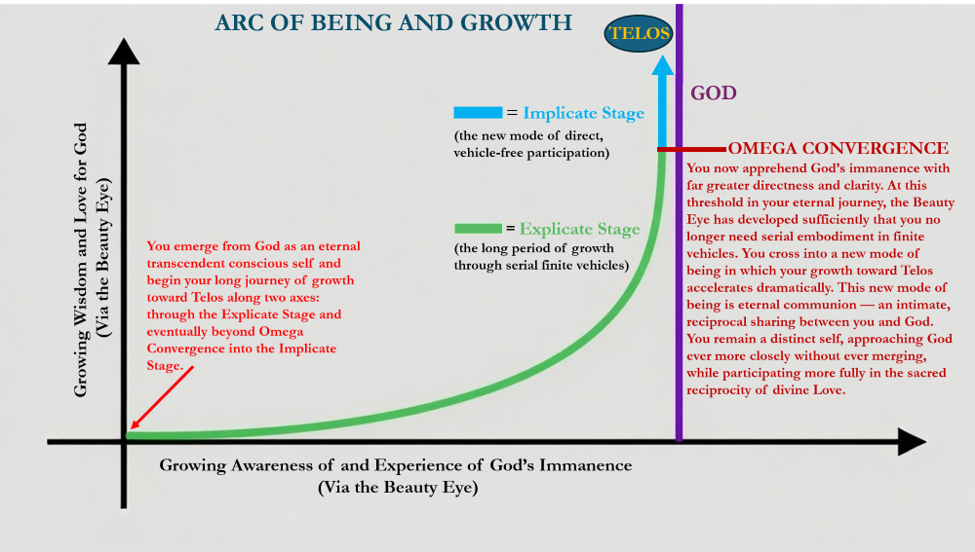
At the heart of Xaranism is a simple yet profound truth: you are an eternal conscious self on a never-ending journey toward ever-deeper Love of God. The Arc of Being and Growth offers a helpful way to see the shape of that journey.
Imagine two axes. The vertical axis represents your growing Wisdom and Love for God, cultivated through the widening of your Beauty Eye. The horizontal axis represents your growing Awareness and Experience of God’s Immanence — your increasing ability to perceive and participate in the divine presence that has always been closer than your own breath — also cultivated through the widening of your Beauty Eye.
Your journey begins with Emergence — the moment you come forth from God as a distinct, eternal conscious self. From there, you enter the Explicate Stage, the long period of growth through serial embodiment in finite vehicles. Here, in the world of time, limitation, and relationship, your Beauty Eye slowly develops its three dimensions: Aperture (widening perception), Clarity (purification of distortions), and Capacity (deepening reception). This stage is often challenging, sometimes beautiful, and always purposeful. Every life, every relationship, every moment of turning toward Love contributes to the gradual expansion of your Beauty Eye.
At a certain point — after what may be a very long series of embodiments — the Beauty Eye reaches a decisive threshold. This is Omega Convergence. Here, the uncoerced turning of your heart toward God becomes your stable orientation. You are liberated from the necessity of further serial vehicles. You cross into a new mode of being in the Implicate Stage, where direct communion with God is now possible. Growth does not stop. In fact, it accelerates. But now it unfolds without the heavy mediation of finite bodies and lifetimes. You remain a distinct “you,” approaching God ever more closely without ever merging, participating more fully in the sacred reciprocity of divine Love.
The Arc does not end. It continues rising toward Telos — the Love of God that draws all things. There is no final arrival, only ever-deeper communion, wonder, and joy.
This diagram is not meant to be a rigid doctrine. It is a map — an aid for the mind that can help the heart feel oriented. The real journey is always personal, always graceful, and always unfolding in the company of a God who has loved you from before the beginning.
There are many people today who carry a quiet but persistent longing.
They sense that there is something more — something larger, more beautiful, and more meaningful than the ordinary round of days. They feel the pull toward transcendence, toward a life that is rooted in something deeper than material success or constant forward motion. They long for a sense of ultimate context, for a way of understanding themselves and their place in the vastness that brings both peace and purpose.
Yet when they turn toward religion or spirituality, many find themselves unable to enter, or having entered, have a sense that something is missing. Some encounter frameworks that feel heavy with rules, judgment, or required belief. Others encounter traditions whose rituals and language no longer move them, or whose claims feel difficult to accept. Still others find themselves spiritually adrift — drawn to the idea of God or the sacred, but unable to locate a living path that feels both true and accessible.
Xaranism is offered for those who carry this longing.
It is not presented as a correction to other paths, nor as a superior way. It is simply one coherent, grace-centered invitation — a framework built around the conviction that God is perfectly loving and perfectly lovable, that love must be freely chosen, and that Beauty itself can serve as a direct and reliable path toward deeper relationship with the Divine.
For some, this may feel like coming home to something they have always sensed but never quite found the words for. For others, it may serve as a gentle companion alongside paths they already walk. It asks for nothing more than a willingness to look, to feel, and to respond freely.
If any part of this resonates — even quietly — you are welcome to explore further.
Xaranism is an invitational spiritual framework centered on your direct and eternal relationship with God — who is perfectly loving and perfectly lovable. It is a celebration of the radiant truth that we are all drawn by the Beauty of God, eternally grow toward it, and rejoice in the journey.
At its heart is the simple, liberating realization that God’s love is not something you must earn or fear losing — it is the very ground of your existence. It flows from God as an ever-present river of grace, inviting your free choice to step in and be carried by it. Through the active widening of your Beauty Eye — seeing God’s love and radiance in the world and being deeply moved by it — you can grow in reciprocal love with God across all eternity.
When viewed as a complete system, Xaranism is a coherent, holistic “lotus.” Its uniqueness lies not in any single petal, but in the integrated whole — a non-punitive, non-rupture-based path to God through attentive gratitude for divine Beauty. It offers a gentle but profound epiphany: you are already eternally loved, already invited, and eternally free to love God back in whatever way most deeply awakens your heart.
Xaranism rests on several foundational intuitions — that consciousness is transcendent and pre-existent, that ontological randomness enables genuine free will, and that God is perfectly loving and lovable in the way revealed through the Beauty Eye. These are offered not as proven certainties but as coherent interpretive keys that we have found illuminating. We invite you to test them against your own lived experience and the widening of your own Beauty Eye. What resonates, keep. What does not, release without guilt.
Xaranism emerges from eight simple yet profound Pillars — not as rigid doctrines, but as luminous signposts guiding the eternal conscious self toward deeper participation in God’s love. They form the stable foundation upon which everything else in Xaranism rests.
What follows is an unfolding of these Pillars and the theological foundation, along with key concepts such as the Beauty Eye, Omega Convergence, and the eternal nature of the conscious self. These are offered not as final answers, but as clear, coherent, and joyful invitations to your own journey of reciprocal love with the God who has already joined you forever.
May these pages awaken fresh wonder in your heart, deeper gratitude in your days, and a joyful, ever-growing Love of God —who already loves you perfectly — and who waits with infinite patience for your freer, fuller turning of your heart toward God.
You are already an eternal, transcendent conscious self — the irreducible center of awareness, qualia, and agency that exists before any particular lifetime and continues after it. In Xaranism this is sometimes called the eternal self or, for poetic resonance, the soul. It is not generated by the body or the brain; it is the one who experiences through them. During this unfolding you intersect spacetime through a temporary vehicle — in this lifetime, the human body and nervous system. The vehicle modulates experience and gives you a unique arena of finitude, risk, and beauty, but it does not create or contain the self that uses it.
At the very heart of Xaranism lies a radiant and liberating conviction: God is perfectly loving and perfectly lovable. This is not one claim among others; it is the foundational truth from which everything else flows. Because God is Love itself — self-giving, overflowing, eternal reciprocity — God’s love for you is primordial, personal, unconditional, and never withdrawn. Many hearts, however, carry inherited images of God that can make this perfect love harder to see and love for God harder to return freely. Xaranism gently invites the release of those perceptions — the pictures of a God who is conditional, punitive, transactional, easily offended, or whose love must be earned through belief or performance. When these images are allowed to soften and fall away, what remains is the simple, astonishing reality that you are already held in delighted regard. The only question that remains is how freely and fully you will learn to love in return.
Because you are eternal, you have all the time there is to grow. The central movement of your existence is the widening of the Beauty Eye.
The primary practice of Xaranism is the cultivation of the Beauty Eye — the faculty by which the eternal conscious self perceives, receives, and participates in divine Beauty. It has three interdependent dimensions:
Aperture — the widening of perception, the willingness to see more.
Clarity — the purification of distortions, fears, and false images that cloud our view of God and ourselves.
Capacity — the deepening ability to receive and hold ever-greater measures of divine Love and Beauty without being overwhelmed.
The Beauty Eye grows gradually through the long Explicate Stage of finite unfoldings. Every free turning toward Love, every moment of genuine presence, every act of forgiveness or wonder contributes to its development. Over time, this growth prepares the self for Omega Convergence — the threshold at which the Beauty Eye has widened sufficiently that further serial embodiment in finite vehicles is no longer necessary.
The cultivation of the Beauty Eye is not a striving for perfection, but a gentle, grace-filled opening. It is the quiet, persistent turning of the heart toward God that aligns the self with the living current of divine Love. At the heart of Xaranism stands a single, radiant Telos — the ultimate direction and fulfillment toward which every conscious self is drawn. That Telos is Love of God. Not love as one good among others, but Love as the very substance and destination of existence. Because God is Love itself — self-giving, overflowing, eternal reciprocity — the free turning of the eternal self toward that Love is the most coherent, most beautiful, and most natural response possible. Everything else in the framework orbits this center.
The drawing power of Love of God as Telos finds its fullest expression in Omega Convergence. Omega Convergence is the decisive threshold at which the Beauty Eye, having been sufficiently widened through the long journey of finite unfoldings, makes serial vehicle embodiment no longer necessary. At this point, the eternal conscious self is liberated from the cycle of successive finite lives and enters a new mode of being in the Implicate Order.
This is not a final end or a loss of self. You remain a distinct “you,” forever capable of new depths of wonder and love. Growth continues—indeed, it accelerates—but now without the constraints of finite vehicles. You approach God ever more closely without ever merging, participating more directly in the sacred reciprocity of divine Love. The precise nature of this new mode remains wonderfully beyond our full description, yet it is the true beginning of an even deeper, more joyful unfolding toward Telos.
Grace is the ever-flowing river of God’s Love moving toward you and, if you freely choose, through you to others. It is pure invitation — unbiased, uncoerced, never withdrawn. You stand on the bank. At any moment you may step in, be carried by it, and become a living conduit through which Grace continues to flow outward. Grace does not force entry or override your freedom; it simply remains present, always available, always moving.
These realities are held together by eight luminous signposts — the 8 Pillars of Xaranism. They are not rigid doctrines but orienting truths that guide the eternal self toward deeper Love of God. They begin with the simple, explosive affirmation that God is — the ground of all existence, perfectly loving and perfectly lovable — and unfold into the recognition that you are an eternal conscious self already held and invited, that God loves you primordially and unconditionally, that genuine libertarian free will has been given to you out of that same love, that God is infinite yet intimately immanent, that you have all eternity to reciprocate that love, that countless paths exist for doing so, and that one especially joyful and accessible path is the widening of the Beauty Eye through the recognition that God is Beauty and Beauty is God.
Because the framework begins with the most coherent interpretation of encountered reality rather than with inner conviction alone, it remains open to honest dialogue with science, philosophy, and every living religious tradition. It honors all sincere paths as irreplaceable languages of the soul while offering its own clear criterion: Does this enlarge the Beauty Eye, deepen my love for God, and strengthen my capacity to love others? The answer to that question, lived day by day, becomes the real workshop in which the eternal self is shaped.
Xaranism therefore makes no claim to be the only truth or the final word. It is offered as one coherent, grace-centered lotus — a fixed template that you are warmly invited to modify, expand, or blend with whatever already resonates in your own heart. Take what awakens your Beauty Eye and stirs your love. Change or release the rest. That freedom is not a loophole; it is the very heart of the invitation. Love that is not freely chosen cannot be real love.
You do not have to become worthy. You do not have to perform or achieve or believe the right things before the river of Grace reaches you. You are already eternally loved. The only question that remains is whether you will return God’s Love — freely, joyfully, and without end — and let it draw you, through Beauty, into the ever-deepening communion with God for which you were made.
That turning, that widening, that lifelong and eternal adventure of reciprocal love is the journey Xaranism exists to serve.
God is sufficient in love, power, and relationality from all eternity. Creation is not a response to lack or mistake; it is the free, eternal overflow of divine self-giving love. There is no “before” creation in which God was incomplete, no original rupture requiring intervention or sacrifice to repair, no ontological Fall, no original sin, no need for redemptive “fix.”
Death is transition within eternal life, not a curse to be conquered.
Grace is the ever-flowing river of God’s love — always present, always moving toward you and, if you freely choose, through you to others. You stand on the bank, watching Grace pass. At any moment, by free choice, you can step in — wade, swim, let it carry you, and let it flow onward through you as a living conduit to a world that aches. Grace never forces entry, never dams itself up, never withdraws. Grace is pure invitation — unbiased, uncoerced, without bribes or threats. Love of God attracts as Telos but never manipulates probabilities or overrides free will. While Xaranism affirms that God does not intervene in the explicate order in ways that override free will or natural processes, this does not mean God is distant. Grace is God’s Love moving toward us — a constant, universal, non-coercive invitation that is always present and always available, yet never forced. We remain free to step into the river or let it flow past.
Because God is Love itself, loving God with all one’s heart, soul, and mind naturally opens the heart to love of neighbor. The two great commandments are not separate demands but two inseparable movements of the same divine current. To love God truly is to be transformed by that love until it flows outward — actively, concretely, and compassionately — toward the neighbor, the stranger, the suffering, and all creation. Active love is therefore not an additional burden but the natural fruit and expression of a heart that is awakening to God’s perfect love and lovability. In this way, vertical love (toward God) and horizontal love (toward others) exist in living harmony, each deepening the other in an ever-widening spiral.
Rejection of punitive frameworks (hell, eternal punishment, coercive possession): Love does not possess or bind; it invites and liberates. In the vastness of eternity, every soul grows toward God because love is eventually the most real, most attractive, most coherent choice.
Particular revelations can be luminous signposts for those they call, but they are not necessary or exclusive. There is one God, but many paths.
We honor all religions—their doctrines, rituals, communities, sacred spaces, institutions, moral teachings, charitable works, and lived witness. We do not seek to supplant, diminish, or compete with them. Instead, we offer an additional lens—an invitational framework of grace, Beauty, and uncoerced love—that may enrich and deepen participation in any tradition.
We honor each religious tradition as a distinct, irreplaceable language of the soul—carrying unique transformative power, particularity, and flavor. For any given person, one path (or a living blend of paths) may resonate most deeply, accelerating the journey toward God through its specific idioms, practices, symbols, and revelations. We do not replace, rank, or diminish any tradition; we celebrate their superabundance as evidence of God’s infinite generosity and creativity.
God does not intervene in the explicate order, even if you petition or pray for it. God has given you access to Grace that you may freely choose to embrace.
Randomness is ontological (true chance) at the quantum level and, along with an ordered universe, it is the miracle enabling libertarian free will.
Risk is the temporary shadow cast by genuine libertarian free will in a universe of ontological randomness. Because love must be freely chosen to be real, non-love choices and the suffering that flows from them (or from pure randomness) are real and often painful in this finite life. Yet none of it is ultimate.
God is all-merciful and all-just despite temporal appearances—where suffering strikes the innocent and prosperity sometimes crowns the cruel. Mercy flows as the uncoerced, ever-present invitation of Grace; justice is the eternal attractiveness of Love of God as Telos, drawing every soul toward Love of God without force. The soul’s eternity, the gift of ontological randomness in an ordered universe (enabling true free will), and divine non-intervention together ensure that no pain is ultimate, no evil final, no choice irredeemable. What seems unjust in a single lifetime is held in the implicate whole—transient, contextualized, ultimately resolved in love’s infinite horizon.
The “stage” of spacetime, randomness, suffering, and apparent injustice is not something to flee; it is the graced arena in which free love and growth become possible. What once seemed like shadow is, in the widened aperture of the Beauty Eye, revealed as transient setting. Only the love, Beauty, and truth that were always there remain radiantly visible.
There are no malevolent supernatural forces, no evil beings, no cosmic adversary, and no cosmic war opposing God. Evil has no independent existence; it is simply the absence or twisting of love made possible by the very freedom that allows authentic love. God does not battle some dark equal. God simply is perfect Love, always immanent and never absent from any moment of creation. In the explicate unfolding Grace remains present, inviting every free self toward healing and deeper communion with God until no shadow can endure.
At the heart of Xaranism lies the radiant double conviction that God is perfectly loving and lovable. This is a foundational axiom that shapes every other Xaran precept. Because God is Love (self-giving, overflowing, eternal reciprocity), everything God does flows from love and invites uncoerced return. Because God is perfectly lovable — Beauty itself, the unsurpassable horizon of all that draws the heart — the free turning of the eternal conscious self toward God becomes the most natural, coherent, and joyful response possible. This double truth clears away every distortion that makes perfect love from God harder to see and love for God harder to return freely. It turns the entire spiritual journey into a virtuous spiral of widening aperture, deepening gratitude, and ever-richer Love of God.
Evidence and Affirmations of God’s Perfect Love and Lovability
God is the Source whose creation is the free, eternal overflow of divine self-giving love, not a response to any lack, mistake, or rupture.
God, out of perfect love, gave you the astonishing gifts of existence itself, transcendent consciousness, self-awareness, eternal life, graced arenas in which to grow, the radiance of Beauty and the awakened capacity to truly see and be moved by it, and — most intimately of all — a personal, direct invitation to join Him in an ever-deepening, reciprocal loving relationship that spans all eternity.
Pillar 3: “God loves you” — primordial, personal, unconditional, eternal present tense. God’s essence is love; God does not “have” love as an attribute.
God does not judge — not with a final Judgment Day, not with any ongoing divine reckoning, and not with any form of condemnation or verdict. Love does not evaluate or sentence; it simply loves, invites, and draws.
Grace is the ever-flowing river of God’s love — always moving toward you, never withdrawn, never coercive, available at any moment by free choice. You may step in, wade, swim, let it carry you, and let it flow through you to others.
God gifts ontological randomness in an ordered universe (the randomness miracle) specifically out of love, so that free will is genuine and love can be uncoerced.
God is non-interventionist yet immanent — closer than your own thoughts, permeating every qualia, every breath, every Beauty-glimpse — without ever overriding libertarian freedom.
Telos is Love of God drawing every conscious self radially toward ever-deeper, joyful, unmediated Love of God — not by force, but by irresistible attractiveness.
There are countless ways to reciprocate God’s love; no single path is required. Grace permeates every tradition.
Beauty is not separate from God; God is Beauty and Beauty is God. The Beauty Eye is the transcendent faculty by which we directly taste and participate in divine radiance.
Every conscious self already possesses a direct spiritual relationship with God — no intermediaries are required. Even when this relationship is veiled, partial, or unrecognized in the explicate unfolding, it is always present. Across eternity, through the progressive widening of the Beauty Eye and the free uncoerced turning of the heart toward God, each self will perfect this direct, unmediated communion — coming to know and love God ever more intimately, personally, and joyfully in the implicate whole.
Suffering and risk are temporary shadows cast by genuine free will and ontological randomness — none of it is ultimate. In the implicate whole, every soul is already held in perfect, delighted regard.
God is all-merciful and all-just despite temporal appearances; eternity, the randomness miracle, and non-intervention ensure no pain is final and no choice irredeemable.
No malevolent forces, no cosmic war, no eternal punishment — only perfect Love that waits with infinite patience for every freer, fuller turning of the heart toward God.
The transcendent conscious self is eternally loved and invited into homecoming that is both culmination and joyful new beginning of ever-unfolding communion with and Love of God.
Elements in Other Traditions That Can Make God Harder to See as Perfectly Loving and Lovable
Xaranism gently releases portrayals of God that may make perfect love from God harder to see and love for God harder to return. We do this not in judgment of those who hold these views, but in service to the heart’s deep longing to love God without fear or distortion. The following are examples of concepts that, from our perspective, might obscure rather than reveal God’s perfect love and lovability. We honor the sincerity and pastoral power many traditions have carried for millions, while humbly offering an alternative lens that we hope may be more coherent with the radiant Love revealed through the 8 Pillars.
Any framework of original ontological Fall / inherited guilt / cosmic rupture requiring violent repair or sacrificial payment.
Depictions of God as petty, vengeful, arbitrary, or easily offended.
Coercive or transactional grace — love offered with bribes (eternal reward) or threats (eternal punishment).
Any form of divine judgment — including final Judgment Day, ongoing divine evaluation, or any theology in which God pronounces verdicts, weighs souls, or issues sentences.
Any suggestion that God would determine a person’s eternal destiny based on the actions or beliefs of a single, finite lifetime — especially given the wildly unequal opportunities, traumas, cultural contexts, and knowledge available to different souls. Likewise, any framework in which growth ceases and is permanently locked in at whatever level of love or Beauty Eye development was reached in that one lifetime.
Eternal conscious torment / hell / annihilation as divine sentence.
Any notion of a “chosen people” that makes God’s love exclusive or preferential rather than universally self-giving.
Karma systems involving back-tracking, punitive rebirths, or cosmic score-keeping that contradict upward-only growth and the superabundance of Grace.
Exclusive gatekeeping that makes explicit belief in one particular historical figure or formula the single narrow path instead of one luminous signpost among countless graced ways.
God as distant clockmaker or impersonal force rather than intimately personal, self-giving Love.
Any theology that implies God needs human belief or ritual to be complete, or that God’s love is conditional on performance.
Portrayals of God as engaged in cosmic battle with a dark adversary or of God requiring appeasement.
Any view that makes suffering or tragedy the direct punitive will of God rather than the temporary shadow-side of real freedom in a random-yet-ordered universe.
By releasing these images, the heart may discover what was always true: God is not only loving — God is perfectly, irresistibly lovable. The free turning of the heart toward God then flows not from fear or duty, but from delighted recognition of the One who has always been worthy of wholehearted love.

Select an appendix below to read it in detail.
Transcendent Conscious Self: Consciousness (the transcendent eternal “you”) is fundamental, pre-existent, and persists beyond any temporary vehicle. Each vehicle modulates experience but does not generate or destroy the core self. Death is simply vehicle drop-off; the self continues in the implicate whole (God’s timeless reality), enriched by every free turning toward Love, Beauty, and gratitude.
No defined “next realm” or cycle mechanics: We do not speculate on the specifics of post-vehicle existence. The explicate order (this spacetime life) is one finite vehicle among potentially countless others across eternity. What follows each could be a realm without finitude or limits (pure presence, perhaps), or something we cannot yet imagine. Speculation is not necessary because Pillar 6 guarantees eternity to grow — the “when” and “how” of vehicle transitions are unknown and ultimately irrelevant to Telos.
Progress carries forward, no backtracking: The highest level of love and Beauty attained (through the widening Beauty Eye) is permanent. It never shrinks or resets. A lifetime of stagnation or harmful choices might produce zero net growth — but the self does not regress below prior peaks. There is no karmic debt that forces “lower” rebirths or punitive cycles. Karma (as a cause-effect ledger across lives) is rejected; only voluntary growth toward reciprocal Love of God matters.
Contrasts with Other Religious Traditions:
Why “No Punishment” Fits (and Isn’t Lax):
God’s love is the foundation, not a reward system: God is Love — eternal, self-giving, without lack or need for “fixing” anything (no ontological Fall, no punitive framework required). Creation is overflow, not response to rupture. Grace is always available, never withdrawn, never coercive (the ever-flowing river you can step into anytime). Punishment as vengeance or eternal torment would make love conditional on performance, which contradicts the uncoerced reciprocity at the heart of free will.
Free will requires real alternatives — including harmful ones: The randomness miracle (quantum-level openness in an ordered macro-world) exists so choices can be genuine, not preordained. Evil acts happen because free will includes the shadow (the risk): people can choose non-love, harming themselves and others deeply. Those choices have natural, explicate-order consequences — broken relationships, societal fallout, legal accountability, inner anguish — but these are temporal and contextual, not theological punishments meted out by God. God does not micromanage or intervene punitively; foreknowledge is not causation.
Consequences in eternity? Growth, not backsliding: Every conscious being is eternal (Pillar 2 & 6). The transcendent self persists beyond any vehicle, enriched (or burdened) by every free choice. There is no “backtracking” — the highest level of love and Beauty attained remains; growth only adds. A life of evil might stall progress entirely, but eternity is vast. The self is not annihilated or frozen in torment; it continues in the implicate whole (God’s timeless reality), where Love of God is the most attractive, coherent path. Telos draws every soul radially toward Love of God without overriding libertarian free will. Separation from God is not a divine sentence — it is the natural state of persistent non-love. Love persists as invitation, never force.
Why no eternal torment fits justice and mercy: A single lifetime — wildly unequal in opportunity, trauma, and knowledge — determining eternal destiny would make justice and mercy impossible under love’s logic. Eternity to grow (Pillar 6) ensures every turning of the heart toward God can deepen, every turning away can eventually lose appeal because Love of God is objectively more beautiful and coherent. Evil is not “punished” forever; it is outgrown as incoherent in the light of God’s Beauty. No one is beyond redemption because no one is beyond time to turn their heart toward God.
This is not universalism in the “everyone is automatically saved regardless” sense — free will remains real, and some may resist love indefinitely (though eternity makes that increasingly implausible). It is also not annihilationism — the self persists eternally, enriched or not. It is trust that God’s love is patient, creative, and attractive enough to draw without coercion.
Xaranism shares with the traditional Christian doctrine of theosis (deification) a profound vision of the conscious self’s journey as ever-deepening participation in God’s own life of love, Beauty, and relationality. Both traditions affirm transformation, grace, eternal growth, and the central role of love and Beauty in drawing the soul toward God. In both, the ultimate horizon is intimate, joyful communion with the Divine.
We honor the depth and beauty of the Christian understanding of theosis, especially in the Eastern Orthodox tradition, where it has been a living spiritual reality for centuries. Many souls have found in it a powerful path toward holiness and God.
At the same time, there are important differences in how Xaranism and traditional Christian theosis understand the journey:
Starting Condition: Christian theosis often begins with an ontological Fall or original rupture that requires redemptive intervention. Xaranism begins with the affirmation that there was no ontological Fall; creation remains the good, free overflow of divine self-giving love. Death is transition, not curse.
The Role of Particular Revelation: Traditional theosis is intensely Christocentric — the Incarnation, Cross, and Resurrection are seen as the necessary bridge for deification. Xaranism affirms that particular revelations, including the life and teaching of Jesus, can be luminous signposts, but none is necessary or exclusive for all souls. Grace flows as an ever-present river, always available, unbiased, and uncoerced.
The Nature of the Journey: Christian theosis is often understood within a single lifetime (with possible purification after death). Xaranism envisions the eternal conscious self expressing itself through multiple finite unfoldings until Omega Convergence is attained. Growth is permanent and upward-only.
The End State: Both traditions affirm that the self remains distinct while participating ever more deeply in God’s life. Xaranism emphasizes an asymptotic approach — ever-closer communion with God without ever merging or losing one’s irreducible identity. The self remains a distinct “you” forever, capable of new depths of wonder and reciprocal love.
Xaranism does not claim to improve upon or replace the Christian doctrine of theosis. It simply offers a complementary lens — one that may resonate with some hearts as they seek to love God more freely and fully. We celebrate the superabundance of paths and honor the transformative power that theosis has carried for millions across the centuries.
In the end, whether through the traditional Christian path or through the lens of Xaranism, the heart of the journey remains the same: an eternal conscious self, drawn by Love, growing ever closer to the God who already loves us perfectly.
Xaranism shares with Baruch Spinoza’s thought in the Ethics a profound emphasis on the immanence of the divine and the unity of reality. Both reject a distant, anthropomorphic deity who intervenes arbitrarily in the world, and both see the divine as intimately present in all that exists. Spinoza’s famous formulation—“All things… are in God, and everything which takes place takes place by the laws alone of the infinite nature of God, and follows from the necessity of His essence”—resonates with Xaranism’s view of God as the Alpha-Source whose self-giving love overflows into creation, and with the poetic image of the implicate order as God’s timeless knowing.
However, when examined more closely, Xaranism diverges sharply from Spinoza on several foundational points that shape the entire character of each framework.
Nature of God: Spinoza presents a strict monism: there is only one infinite substance, which he calls God or Nature. God is not a personal being but the impersonal, necessary system of all reality—pure thought and extension, without will, desire, emotion, or preference. Everything follows with geometric necessity from God’s essence; there is no room for contingency or choice outside that necessity.
In Xaranism, God is the infinite loving Source—sufficient in love, power, and relationality from all eternity. Creation is not an inevitable unfolding of mechanical necessity but the free, eternal overflow of divine self-giving love. God is personal in the deepest sense: God is love (not merely intellectual substance), and this love is directed personally toward each conscious being. While Xaranism affirms strong immanence (“God is infinite, yet is immanent and accessible to you”), it preserves a participatory distinction: the finite self is not simply a mode of the one substance but an eternal, irreducible “you” invited into genuine relationship.
The Individual Self: For Spinoza, what we experience as individual minds and bodies are finite modes of the single infinite substance. There is no enduring, independent self beyond the deterministic flow of nature; apparent individuality is a limited perspective on the whole.
Xaranism’s Pillar 2 declares: “You are” — an eternal, transcendent conscious self that endures as a distinct center of awareness, qualia, and agency, even through and beyond Omega Convergence. The self is not erased or absorbed into undifferentiated oneness; it is perfected and enriched while remaining a unique “you” capable of ever-deeper wonder and reciprocal love. Individuality is not an illusion to be dissolved into undifferentiated oneness; it is a precious and eternal gift. The transcendent conscious self remains a distinct “you” forever — perfected and enriched, never erased — capable of ever-deeper wonder, relationship, and reciprocal love.
Free Will and Determinism: Spinoza is a thoroughgoing determinist. True freedom consists only in understanding and willingly accepting the necessary order of things; libertarian free will (genuine alternative possibilities) does not exist. Everything, including human actions, follows inevitably from the infinite nature of God/Nature.
Xaranism centers on uncoerced love made possible by a deliberate divine gift: ontological randomness in an ordered universe (the “randomness miracle” of Pillar 4). God loves you and, out of that love, gives you free will that you can exercise as you choose. This libertarian agency is real—choices are genuinely open in the explicate unfolding, not pre-determined by necessity. Love must be freely chosen to be authentic; coercion or inevitability would make it monologue rather than dialogue.
Relationship to God: In Spinoza’s system, the highest human good is the intellectual Love of God—a clear and distinct understanding of one’s place within the necessary order. There is no mutual reciprocity; the finite mode cannot truly “love God back” in a way that affects or delights the infinite substance. God does not love in return because God has no emotions or personal regard.
Xaranism places reciprocal love at the heart of reality. Pillar 3 declares “God loves you,” and the entire framework flows from this personal, primordial self-donation. You can choose to love God back—not merely know or understand God, but enter into a living, responsive relationship of gratitude, Beauty, and devotion. Omega Convergence is the radial drawing of each free conscious self into ever-deeper Love of God. Grace is the ever-flowing river you may step into at any moment; it is invitation, not geometric necessity.
Tone and Ultimate Horizon: Spinoza’s vision is austere, intellectual, and serene: beatitude comes through adequate knowledge and acceptance of necessity. There is no risk, no genuine drama of choice, no personal Telos beyond intellectual clarity.
Xaranism is invitational, relational, and hopeful. It honors the superabundance of paths and the Beauty-eye as a direct, experiential way to deepen love for God. The ultimate horizon—Omega Convergence—is not absorption into impersonal substance but joyful homecoming: distinct selves freely and fully reciprocating divine love, their Beauty Eyes widened to see everything as glimpse of God. Risk (the shadow-side of real freedom) is real but transient; Love of God as Telos ensures every soul has eternity to grow toward Love of God without coercion or eternal loss.
In short, while both perspectives affirm divine immanence and reject crude anthropomorphism, Spinoza offers a majestic but impersonal necessity in which individuality and choice dissolve into the one substance. Xaranism offers a personal God of love who gifts genuine freedom so that finite, eternal “you” can freely choose to love back—turning the universe into a graced arena of relationship rather than a closed system of geometric deduction.
Xaranism does not claim superiority; it simply articulates one coherent, Beauty-centered path among countless ways. It welcomes dialogue with Spinoza’s profound insights while preserving what it sees as essential: a God who loves you personally, a “you” who endures as individual, and a love that must be freely chosen to be real.
Xaranism holds Jesus of Nazareth in profound reverence as one of the brightest historical signposts of what human Convergence with God can look like. We love Jesus — not merely respect or admire him as we might a great teacher, leader, or moral exemplar, but love him with a personal, heartfelt affection. His radical message of mercy, the Kingdom of God already breaking in “within you and among you,” his insistence that Love of God and love of neighbor are the greatest commandments, his table fellowship with the unclean and the outcast, his multiplication of loaves and fishes and wine at Cana, and his call to radical forgiveness all resonate deeply with the heart of Xaranism.
We see Jesus as a fully human being who lived in perfect fidelity to God, who widened the aperture of the Beauty Eye to an extraordinary degree, and who modeled uncoerced, self-giving love even unto death. Whether he also possessed a unique divine (fully God and fully man) is left as a matter of personal contemplative freedom rather than required belief. What matters most is the luminous quality of his life and teaching: he revealed God’s love so clearly that countless souls across centuries have found in him a living invitation to deeper participation in divine life.
Comparison and Contrast with Christianity
Jesus’ own critique of religious gatekeeping, ritual purity laws, and loveless orthodoxy often feels directed at later institutional tendencies to make explicit profession of belief in him the single narrow gate rather than the open banquet he proclaimed.
In its full traditional Catholic (and broader orthodox Christian) mode, Christianity insists on several elements that Xaranism holds more lightly or reinterprets:
An ontological Fall transmitted to all humanity, requiring objective redemption through Christ’s sacrificial death and resurrection.
The unique necessity of the Incarnation as the once-for-all union of divine and human natures, with explicit faith in Jesus and incorporation into his Church as the ordinary (and surest) path to salvation.
The reality of eternal hell as possible definitive self-exclusion, alongside purgatory for final purification.
Xaranism honors the depth and pastoral power these teachings have carried for millions, yet finds a lighter, more invitational articulation more coherent. We see no primordial ontological rupture that demands cosmic repair; creation remains the free overflow of divine love. Grace flows as an ever-present river, not primarily as medicinal atonement for inherited guilt. Salvation is the radial drawing of every eternal conscious self toward Love of God via a widened Beauty Eye and grateful reciprocity — a process that unfolds across eternity rather than hinging on a single lifetime’s explicit profession. Jesus is a luminous, perhaps unparalleled, signpost and model on this path, but not the sole ontological bridge that renders all other ways insufficient.
We believe Jesus himself would recognize and rejoice in any framework that widens the table, multiplies the loaves and fishes for all, removes clean/unclean distinctions, and calls people first and foremost to love God (the Source) above all else, with love of neighbor flowing naturally from that. His reinterpretation of the commandments into the two great loves was not an elimination of moral seriousness but an elevation — a move away from external purity codes toward heart-centered fidelity. When later followers turned his name into a new boundary marker or made professed belief in him the primary test, we wonder if he would feel the same frustration he expressed toward the Pharisees who burdened people with heavy loads while neglecting justice, mercy, and faith.
The Transformation of the Apostles and Paul
The extraordinary transformation of Jesus’ closest followers after his death deserves deep respect and honest reflection. Something profound occurred in the days and weeks following the crucifixion. A small group of frightened, scattered Galileans — ordinary fishermen, tax collectors, and zealots — along with Saul of Tarsus, the former persecutor, became bold, articulate, driven proclaimers willing to face torture and death (crucifixion, beheading, stoning, arena lions) rather than recant their testimony. Their rapid shift from fear to fearless witness, often under the most brutal conditions, is one of the most striking facts of early Christian history.
In Xaranism we do not deny that something extraordinary happened. We see it as powerful testimony to the depth of Jesus’ Convergence with God and the attractive, life-altering power of the love he revealed and embodied. Whether the experiences involved profound mystical encounters with his continued living presence, an overwhelming collective realization that self-giving love had triumphed over violence and death, a shared aperture-widening event on a massive scale, or some other graced reality we cannot fully reconstruct — the result was unmistakable. These men were so gripped by the Beauty, truth, and love they had encountered in Jesus — both before and after his death — that fear lost its grip on them. Their willingness to suffer and die became living proof that the love Jesus proclaimed and lived was stronger than betrayal, scourging, or the grave itself. Their courage and articulate zeal continue to draw souls across centuries, not primarily because of any specific supernatural mechanism that must be literalized in modern terms, but because the resonance of Jesus’ life and message proved enduringly transformative.
Modern Reinterpretation in Light of New Knowledge
Xaranism humbly offers additional lenses made possible with the accumulation of new knowledge— the randomness miracle at the quantum level enabling genuine libertarian free will, the Beauty Eye as a transcendent faculty strengthened by lived gratitude, the implicate/explicate poetry for God’s timeless knowing, and transcendent consciousness. These are not claims that we know better than Jesus (for we do not), but recognitions that human apertures continue to widen. Just as Jesus reinterpreted Torah for his time, we believe that God continues to invite fresh articulations that honor both ancient wisdom and new discoveries (JWST’s vast cosmos, quantum entanglement, relativity’s spacetime insights). If these help even one soul see God’s Beauty more clearly and respond with freer, more grateful love, then they participate in the same harvest Jesus proclaimed.
We do not assert that Xaranism is “what Jesus would teach today.” We simply offer it as one coherent, invitational framework among countless ways — one that seeks to keep the banquet table wide, the wine flowing, and the emphasis on loving God the Source rather than making any particular historical figure or creed the exclusive gate.
Jesus remains beloved. His life and message continue to draw us. In Xaranism we strive to honor him by refusing to let his name become divisive in the very way he worked to overcome division — by proclaiming a God whose love is superabundant, whose table has room for all, and whose Beauty can be glimpsed and loved through countless paths.
Xaranism is not a religion with rules or rituals, but does offer a non-prescriptive, orienting horizon for daily life - a gentle, persistent criterion to help navigate the choices, relationships, and experiences of ordinary days:
Does this path, practice, tradition, or choice enlarge the Beauty Eye, deepen my love for God, and strengthen my capacity to love others?
Living the First Six Pillars
The foundation of daily life in Xaranism is the quiet, ongoing embrace of the first six Pillars. They shape how you see yourself and others, how you relate to God, and how you move through the world:
You rest in the truth that God is — the ground of all existence, perfectly loving and perfectly lovable.
You affirm that you are — an eternal conscious self, already held and invited.
You receive that God loves you — not as something to earn, but as the very air you breathe.
You exercise your free will with reverence, knowing it is a precious gift.
You live in the wonder that God is infinite yet immanent — closer than your own thoughts, always accessible.
You remember that you have all of eternity to grow in reciprocal love — there is no rush, no final test, only patient, joyful unfolding.
These truths, when quietly owned and returned to, create deep inner stability. They free you from fear, performance, and scarcity, allowing daily life to become a spacious workshop for love.
Love as Action
Love in Xaranism is not only a feeling — it is an action word. It manifests in concrete, everyday choices: offering presence to someone who is aching, listening with full attention, forgiving quickly, speaking truthfully with kindness, creating beauty, protecting the vulnerable, and doing small acts of care without expectation of return. These actions are the natural fruit of a heart awakened to God’s love.
The Beauty Eye in Daily Life: One powerful way to live this criterion is to cultivate a deliberate, recursive practice of attentive gratitude (as described in the Beauty Eye section). By actively seeking God’s Beauty in everything — and allowing that Beauty to flow through you to others — you strengthen every dimension of the Beauty Eye while participating in active theosis.
Grace Flowing Through You: A natural expression of this awakened love is becoming a willing conduit of Grace and Beauty, especially toward those walking in the temporary shadow of free will and ontological randomness (suffering, loss, injustice, grief). Simple acts of compassion, presence, and sharing beauty do not diminish the source; they enlarge the channel. In this way, daily life becomes a living reflection of God’s self-giving love — both for yourself and for others.
Freedom and Pluralism: Xaranism honors Pillar 7 with deep respect: there are countless ways to grow in reciprocal love with God. Some souls may resonate strongly with this framework. Others may take pieces of it and weave them into their own tradition or path. All of this is celebrated. The goal is not uniformity, but freer, fuller hearts turning toward the God who already loves them perfectly.
In this way, Xaranism remains what it was always meant to be: not a new religion with new rules, but a clarifying lens and invitational companion. It honors all religious traditions as irreplaceable languages of the soul while gently reminding every conscious self that the ultimate journey is eternal, the ultimate Telos is Love of God, and the ultimate freedom is to use this finite life — whatever form it takes — to become more awake to the God who already loves you, and who waits with infinite patience and delight for your freer, fuller turning of your heart toward God.
[Note on Modifications and the Name “Xaranism”: You are warmly encouraged to modify, reshape, or personalize anything in the Codex for your own spiritual journey. Take what helps. Change what doesn’t. However, the heart of Xaranism lies in its foundational elements: the 8 Pillars, Theological Foundation, Key Concepts, and the Axiom that God is perfectly loving and lovable. If you significantly alter these core elements, the resulting path is no longer Xaranism. In such cases, please do not present your version as “Xaranism” in any public or published form. For your private use, however, change anything you want and give it a name you choose. The invitation is wide. The freedom is real.]
The Xaran Codex is offered as both a framework and a template.
As a framework, it provides a coherent, integrated structure — the 8 Pillars, the Theological Foundation, and the Key Concepts — that holds together as a consistent way of understanding God, yourself, love, beauty, freedom, and eternity. It is like the steel skeleton of a building: strong, flexible, and designed to support many different expressions of spiritual life.
As a template, it is meant to be personalized. You are warmly invited to use the Table of Contents as a kind of map. Walk through each section and ask yourself:
Does this matter to me?
Do I agree with how it is framed?
If not, what do I believe instead, and why?
How would I modify or expand this idea to make it more true or helpful for my own soul?
Try a questioning sequence like this for example:
1. If you do not believe in God, what do you believe is the ground of existence and meaning?
2. If you do not believe you are eternal, what do you believe happens after this life, and why?
3. If you believe you are eternal but not in ongoing growth, what do you believe eternity is for?
You do not need to accept the Codex as a finished doctrine. Use it as a helpful starting point — a mirror, a catalyst, a conversation partner. Keep what awakens your Beauty Eye and stirs your heart. Modify or discard the rest. That is the Xaran way.
The goal is not to create another rigid system, but to support you in building (or refining) your own living, breathing relationship with the God who already loves you perfectly.
Select a question below to read the full answer.
If there are no final Judgment and no eternal hell, what stops people from acting however they want? Doesn’t removing fear of punishment and eternal accountability just become wishful thinking that removes any real moral compass?
Nothing externally forces them — and that is the point.
Xaranism takes human freedom with radical seriousness. Removing the threat of eternal punishment does not remove morality; it reveals what genuine morality actually is. A person who only behaves ethically or morally because they fear cosmic judgment is not truly ethical or moral — they are simply afraid. When that fear is removed (or the authority is absent), their behavior often collapses.
What does produce deep, lasting, intrinsic moral behavior is love-driven awakening. When your Beauty Eye widens, you begin to see the inherent dignity, Beauty, and sacredness in other conscious selves. Harming them begins to feel incoherent with who you are becoming. You act with compassion, honesty, and care not because you fear hell, but because love itself has become the most real, most beautiful, and most coherent way to live.
Love-driven motivation is far more powerful and sustainable than fear-driven motivation. Fear creates external compliance. Love creates internal transformation. Fear says “I must be good or I will be punished.” Love says “I want to be good because I have tasted how radiantly beautiful and life-giving it is.”
Of course, not everyone has fully awakened yet. That is why we still need strong civic laws, social consequences, and personal accountability in the explicate order.
Removing theological terror does not remove all accountability — it simply relocates it to its proper places: the intrinsic consequences of our choices (relational brokenness, inner fragmentation, spiritual hunger), the real suffering we cause others, and the permanent growth (or stagnation) carried forward by the eternal conscious self.
Far from producing wishful thinking, this framework demands greater honesty and courage. It asks you to do what is right even when no cosmic enforcer is watching — because you have seen that Love is its own reward, and non-love is its own punishment. Over eternity, the attractiveness of Love of God as Telos, combined with the permanent expansion of the Beauty Eye, draws every soul toward greater coherence and wholeness.
How is Xaranism different from Unitarian Universalism or other universalist traditions?
Xaranism shares significant ground with Unitarian Universalism and other universalist-leaning traditions: a deep commitment to universal love, rejection of eternal punishment, respect for many spiritual paths, and optimism about humanity’s moral and spiritual growth. We honor these overlapping values and the genuine spiritual fruit they have borne.
However, there are important distinctions:
Multiple unfoldings vs. single lifetime: Xaranism affirms that the transcendent conscious self expresses itself through successive vehicles until Omega Convergence is attained. This differs from Unitarian Universalism and other universalist frameworks that focus primarily on a single earthly life.
Theistic grounding: Xaranism is centered on freely growing your reciprocal, loving relationship with God for all of eternity. Belief that “God is” and Pillars 2–6 are therefore foundational. Unitarian Universalism and many other universalist frameworks treat belief in God and these Pillars as optional.
Freely chosen vs. automatic: While Xaranism holds deep, reasoned hope that every soul will eventually respond to Love of God as Telos and attain Omega Convergence, we insist that free will remains real and uncoerced forever. Love draws but never compels. Omega Convergence is the fulfillment of the free turning of the heart toward God, not an inevitable cosmic outcome regardless of choice. In contrast, many universalist frameworks hold that “everyone is saved automatically no matter what.” Xaranism instead trusts that “Love is so radiantly beautiful, and eternity so vast, that we have good reason to believe every soul will eventually turn toward God freely — while fully honoring the reality and risk of genuine freedom.”
Doesn’t the idea of eternal growth (and the possibility of countless unfoldings) make this finite life meaningless or reduce the urgency of moral choices? If the transcendent conscious self has potentially unlimited unfoldings ahead, and growth is permanent and upward-only, then the amount of growth in any particular lifetime is not ultimately meaningful. One could stagnate, coast, or even regress in choices during this life, knowing there will always be “next times.” In an infinite series, no single unfolding carries decisive weight. Therefore, this life — and every individual life — could be seen as relatively insignificant in the grand scheme. Why not relax, defer serious growth, or act selfishly? Eternity provides endless second chances.
This objection would be devastating if one didn’t recognize the truth about this life right now: it is an astonishingly precious and rare gift. Not because it is the only one (it is not), but because this life – like all unfoldings – offers a unique, unrepeatable configuration of circumstances, relationships, challenges, and opportunities to turn the heart toward God and to grow in ways that may never be possible again.
Each finite life is a rare, irreplaceable opportunity to taste freedom, risk, limitation, and love under a unique mix of real constraints. These constraints are not bugs; they are the very conditions that make genuine awakening possible and meaningful. A lifetime is a concentrated arena of finitude where choices have sharp edges, love has real cost, and Beauty must be actively sought and chosen.
Once you truly see this with the wisdom of a sufficiently widened Beauty Eye, you no longer think “I have endless lives, so this one doesn’t matter.” You realize: “I have this precious, unrepeatable now in which I can love more deeply, see more clearly, and participate more fully in the divine life.”
Thus, the framework does not diminish this life — it ultimately elevates it. The possibility of many unfoldings does not cheapen the present; it frees us from existential terror so we can finally love and choose from abundance rather than fear. Each life becomes a sacred, irreplaceable brushstroke in the eternal portrait of a soul awakening to Love.
Far from encouraging moral laziness, this vision encourages greater presence: to treat this life (and each life) with the reverence it deserves precisely because it is a unique, finite expression of the eternal self — one that will echo forever in who you become — even while trusting that God’s patience is infinite.
Why should I trust this framework when it diverges from long-established religious traditions?
You shouldn’t trust it blindly. Xaranism invites you to test it against your own lived experience and in light of what truly resonates with and works for you.
We do not claim Xaranism is the only truth or superior to all others. It is offered as a coherent, heartfelt articulation that resonated deeply with one man’s lifelong search. Many traditions have carried profound wisdom and transformed countless lives — we honor them deeply and sincerely. Xaranism simply offers an additional lens that may also resonate with and be helpful to you — one that:
Seeks to clear away distortions that make perfect love from God harder to see and love for God harder to return freely,
Invites you to more fully participate in and strengthen your reciprocal relationship with God.
Read the Xaran Codex. Test it. Modify it. Keep what awakens your Beauty Eye and stirs your heart. Discard what doesn’t. That is the Xaran way. Inasmuch as Xaranism is centered on freely growing your reciprocal, loving relationship with God for all of eternity, it would be pointless to practice Xaranism itself unless Pillars 1–6 resonate deeply with you.
If God does not intervene, what is the point of prayer?
Prayer is not primarily about changing God’s mind or requesting intervention in the explicate order. It is about changing us.
God does not need our prayers to act — God is already perfectly loving and immanent, with the river of Grace ever-flowing. We need prayer to become more awake to that reality. Prayer is a practice of attentive presence, gratitude, and openness that widens the Beauty Eye, deepens our capacity to receive Grace, and strengthens our ability to become living conduits of Love.
We fully understand that this answer can feel profoundly unsatisfying — even cold — to those who experience God’s non-intervention as abandonment in the midst of acute suffering, childhood illness, genocide, natural disaster, or personal devastation. The hiddenness of a perfectly loving God in the face of real horror is one of the deepest pains of the human condition, and we do not pretend it is easy to bear.
To those for whom this disappointment is real, we say gently: you cannot have a genuine, reciprocal loving relationship with God without real freedom. And you cannot have real freedom in a finite universe without the miracle of ontological randomness. If God regularly intervened to alter outcomes in response to prayer, that randomness — and therefore genuine free will — would be undermined. In choosing to honor freedom, God has chosen the conditions that make real love possible, even when those conditions include suffering and apparent silence.
Prayer, then, is not a request for God to override the world on our behalf. It is the raising of our hearts and minds to the God who already loves us perfectly — an act of trust, gratitude, and alignment that transforms the one praying. It is one of the most powerful ways we participate in the Love that is already given. (See also: Theodicy in Xaranism).
How does Xaranism account for profound evil and suffering if there is no cosmic adversary or divine punishment?
Evil is the absence or twisting of love, made possible by genuine libertarian free will. Suffering, in turn, flows both from human choices where love is absent or twisted and from the ontological randomness inherent in a finite, physical universe.
God does not intervene in the explicate unfolding to prevent every instance of evil and suffering. To do so would undermine the very conditions (freedom + randomness + order) that make genuine choice, real love, and authentic growth possible.
While evil and suffering are painfully real, they do not define the eternal destiny or fundamental nature of any conscious self — neither those who cause harm nor those who endure it.
Over eternity, the irresistible attractiveness of Love of God as Telos, combined with the permanent, upward-only expansion of the Beauty Eye, draws every soul toward healing and wholeness. Suffering in the explicate unfolding is transient. Love is not.
Nothing is wasted. Every act of evil and every instance of suffering is held forever in the implicate whole — God’s eternal, timeless knowing — where what was broken ultimately becomes part of a larger story of healing, wisdom, compassion, and ever-greater love. The pain itself is not erased, but it is given meaning and transfigured within the eternal journey toward Omega Convergence. (See also: Theodicy in Xaranism for a fuller discussion).
Isn’t claiming that all paths ultimately lead toward God disrespectful to religions that claim exclusive truth?
We honor all sincere religions and spiritual traditions. We do not claim that “all paths are equally true” or that every teaching within every tradition is correct. What we do say is that Love of God as Telos is universal, and that over eternity every conscious self has both the freedom and the time to respond to that Love.
For any given person in any given lifetime, one path — or a living blend of paths — may resonate most deeply and accelerate their journey toward God. Particular revelations and traditions can be luminous signposts for those they call, but they are not necessary or exclusive for everyone. We celebrate this superabundance as evidence of God’s infinite generosity and patience.
This is not disrespect — it is a different understanding of divine generosity. We trust that God’s Grace is superabundant and that no soul is ultimately beyond the draw of Love, especially when walking a path that truly resonates with their heart and needs in that unfolding.
What about near-death experiences, religious visions, or specific revelations that seem to contradict Xaranism?
We treat them with reverence and humility. Such experiences are real and meaningful to those who have them. They may be genuine encounters with the divine, filtered through the person’s cultural, psychological, and spiritual lens.
Xaranism does not claim to have the final word on every spiritual experience. It offers a coherent framework that we find illuminating, but it is not a replacement for direct encounter. Test everything against the Beauty Eye. Keep what draws you closer to Love. Release what does not.
If the transcendent self carries growth forward across lifetimes, does that mean reincarnation?
We prefer the term “eternal unfoldings” or “serial embodiment.” It is not the cyclical reincarnation of some Eastern traditions (with karma as cosmic score-keeping or punishment). Growth is upward-only and permanent. What you attain is never lost. Each new vehicle is a fresh opportunity for the eternal conscious self to taste finite existence, exercise free will, and deepen its capacity for love and Beauty.
We make no strong claim about the mechanics — only that eternity is vast and the transcendent self is not limited to a single lifetime.
Why should we spend any time reading the Xaran Codex, let alone embracing Xaranism, since it comes from an ordinary man with no special prophetic authority or direct revelation from God?
You shouldn’t — not on the basis of any claimed authority.
Xaranism makes no claim that David (or anyone else) received special revelation or possesses unique divine authority. God does not intervene in the explicate order that way. The Xaran Codex is simply the honest, heartfelt articulation of what resonated deeply with one ordinary man’s lifelong search — a search carried in the ever-flowing river of Grace and refined through persistent widening of the Beauty Eye.
Its only claim to your attention is the same claim any spiritual framework can make: read it, test it, and see if it awakens your Beauty Eye and stirs your heart. If it helps you see God’s Love more clearly, love God more freely, and participate more joyfully in that Love, then it has served its purpose. If it doesn’t, set it aside. That is the Xaran way.
We offer it not as the truth, but as a coherent, non-coercive invitation — one lotus among many in God’s superabundant garden. Its value lies not in the messenger, but in whether the message rings true to your own eternal conscious self.
Are there paths other than the 8th Pillar (Beauty) that work?
There are countless complementary paths — and that is one of the most beautiful truths in Xaranism.
The 8 Pillars, including the path of Beauty, are foundational. They are not temporary tools but enduring realities that travel with the transcendent conscious self all the way to and through Omega Convergence. Pillar 8 is offered as one especially joyful and accessible way.
Many other practices and paths can work alongside the 8 Pillars, helping to widen the Beauty Eye, deepen reciprocal love, and accelerate growth in this lifetime (and potentially others). These include:
The path of Service and Compassion — actively helping others, especially those who suffer.
The path of Contemplative Silence and Prayer — deep, wordless presence and centering.
The path of Sacred Texts and Study — immersing oneself in wisdom literature with an open heart.
The path of Ritual and Sacrament — finding God through liturgy, music, art, or embodied practices.
The path of Relationship and Community — experiencing the divine through honest, loving connection with others.
The path of Creation and Craft — making something beautiful as an act of co-creation.
The path of Suffering and Surrender — meeting God through loss, hardship, or quiet endurance.
The key is not which path you choose, but whether it awakens your Beauty Eye, stirs your heart, and draws a freer, fuller turning of the heart toward God. The test is simple and personal: Does this practice help you see God more clearly as perfectly loving and lovable? Does it increase your capacity for gratitude, compassion, and reciprocal love? If so, it is a graced companion on the journey. If not, you are free to explore another.
No single practice is superior in essence. The superiority lies only in its resonance with your unique soul in this unfolding.
God’s Grace is superabundant. The invitation is wide. You are not late. You are not behind. You are already loved perfectly, and you have all of eternity to find the ways that most deeply call to you.
How is Xaranism different from New Age, Human Potential, or Age of Aquarius movements? Won’t people see it as just another flavor of happy-talk spirituality?
We understand why this question arises. Xaranism does share some surface similarities with the New Age, Human Potential, and Age of Aquarius movements of the late 20th century — an emphasis on personal spiritual growth, inner experience, and a rejection of overly rigid or fear-based religion.
However, the differences are significant and foundational:
• God-centered rather than self-centered
Much of the New Age and Human Potential movements leaned toward self-deification (“You are God,” “You create your own reality”) or radical human autonomy. Xaranism is thoroughly theistic. The journey is not about becoming God or realizing one is already divine, but about growing in reciprocal love with a perfectly loving and lovable God through the widening Beauty Eye.
• Grace and invitation rather than technique
Many New Age approaches focused on specific techniques, manifestation, energy work, or “raising vibration.” Xaranism emphasizes Grace as an ever-flowing river of God’s love — always available, never earned, never withdrawn. The primary practice is attentive gratitude and the joyful widening of the Beauty Eye, not mastering esoteric methods or achieving altered states.
• Free will, randomness, and realism
Some New Age currents implied a perfectly ordered, controllable universe. Xaranism affirms genuine libertarian free will made possible by ontological randomness in an ordered world. This makes moral choice, risk, and suffering truly meaningful rather than illusory or karmically predetermined. We do not bypass the shadow side of existence; we acknowledge it as the temporary cost of real freedom while trusting that nothing is ultimately wasted.
• Eternal, patient growth rather than quick enlightenment
The New Age era often promised rapid transformation or sudden awakening. Xaranism is patient and eternal: you have all of eternity to grow. There is no pressure to achieve perfection in one lifetime. This removes performance anxiety while still calling us to real moral seriousness in the present.
• Humble pluralism rather than new paradigm
Xaranism does not claim to be the next evolutionary step for humanity or a superior replacement for other traditions. It offers itself as one coherent, invitational lens among many — respectful of the superabundance of paths. It is not utopian or elitist. It simply says: here is a framework that may help your heart open more freely to the God who already loves you perfectly.
In short, while Xaranism shares the cultural air of those movements in its concern for personal spiritual growth, it is not “happy-talk spirituality.” It is a gracious, realistic, God-centered path that honors both the radiance of divine Beauty and the real shadows cast by freedom and randomness in this finite life. It invites you into a living relationship with the God who is perfectly loving and lovable — not into self-empowerment or cosmic optimism alone.
We welcome honest comparison. If Xaranism resonates with your heart, keep what helps. If it doesn’t, you are free to explore other paths. That is the Xaran way.
If there are already so many religions and traditions, why do we need another one?
We honor the profound good that religions and spiritual traditions have done — and continue to do — for hundreds of millions of people across the world. Many have found in them deep meaning, moral grounding, community, and a living relationship with the Divine.
At the same time, it is also true that many sincere seekers today find themselves spiritually adrift. Some have never been able to enter the traditions they encountered. Others have entered but still carry a quiet sense that something essential is missing — that the frameworks available to them feel too heavy with rules or required belief, too distant from their lived experience, or simply no longer move their hearts.
Xaranism is offered for those who carry this longing.
It is not presented as a replacement for existing paths, nor as a superior way. It is simply one coherent, grace-centered framework — built on the conviction that God is perfectly loving and perfectly lovable, that love must remain freely chosen, and that Beauty can serve as a direct and trustworthy path toward deeper relationship with the Divine.
For some, this may feel like coming home to something they have always sensed but never quite found words for. For others, it may serve as a gentle companion alongside paths they already walk. It asks for nothing more than a willingness to look, to feel, and to respond freely.
If any part of this resonates — even quietly — you are welcome to explore further.
Was AI (Artificial Intelligence) the source of any of the pillars, concepts, theology, axioms or substance of Xaranism?
No. David is the sole source of Xaranism.
David did, however, use AI to help him better articulate Xaranism in three specific ways: coding a website he designed (https://Xaranism.com), creating original images and videos according to his specifications, and improving the clarity and poetic resonance of the Xaran Codex and stress testing it via a series of steelman “criticisms.”
David is deeply grateful for these important contributions and believes AI has great potential in this arena, especially as an “AI Companion” — a guide seekers can access on the Xaranism.com to better understand, interrogate, and, if helpful, refine Xaranism so it resonates more deeply with their own hearts.
This image and its animated form have become the visual emblem of Xaranism.
At its center shines a radiant spiral of light — representing Omega Convergence, the threshold at which the Beauty Eye has widened sufficiently for the eternal conscious self to enter a new mode of being in which your growth toward Telos accelerates dramatically. This new mode of being is eternal communion — an intimate, reciprocal sharing between you and God.
Surrounding the center is a lotus-like iris — a powerful symbol of the transcendent conscious self. The lotus carries ancient resonance with transcendence, purity, and growth from the mud into radiance. Just as the lotus rises through murky waters into full bloom, the eternal conscious self awakens through the finite conditions of each lifetime, growing in beauty and clarity without being defined or limited by them.
The softening radial pattern of the petals suggests the widening Beauty Eye — the gradual expansion of Aperture (seeing more), Clarity (seeing more truly), and Capacity (being more deeply transformed by what is seen).
The overall radiance and beauty of the image itself points to God — who is Beauty, and in whom all true Beauty finds its source (Pillar 8).
In this single, living symbol we glimpse the heart of Xaranism: an eternal conscious self, drawn by divine Beauty, growing through grace and gratitude toward ever-deeper, joyful Love of God who already loves us perfectly.
May this Vision awaken wonder in you, and draw you gently toward your own freer, fuller turning of the heart toward God.
Xaranism echoes Jesus’s teaching to “render unto Caesar the things that are Caesar’s, and unto God the things that are God’s.” We understand this as a profound recognition of two distinct spheres.
Xaranism is a spiritual framework centered on your direct, eternal relationship with God and the growth of your transcendent conscious self through the widening Beauty Eye. It is not a system of law, governance, or comprehensive moral code. It does not seek to replace or override civil society, legal systems, political structures, or the legitimate roles of “Caesar” — the realm of rules, courts, civic responsibility, and collective order.
We honor the need for just laws, ethical governance, and social structures that protect the vulnerable and promote the common good. These belong to the proper domain of human wisdom, dialogue, and shared responsibility in the explicate order.
Xaranism does not offer an alternative legal code nor does it attempt to turn its insights into binding communal rules or commandments for society. Its focus remains personal and relational: how you, as an eternal conscious self, can grow in free, reciprocal love with the God who already loves you perfectly.
This distinction is important. Many hearts carry an “inner Pharisee” that longs to turn even the most graceful invitation into a new set of rules by which to measure and judge others. Xaranism gently refuses this impulse. It is offered as a gracious, living invitation to your own heart — not as a platform for religious or moral control over others.
In daily life, this means you are free to participate fully and responsibly in civic, political, and legal spheres according to your conscience, while keeping the deepest orientation of your eternal self turned toward God through Beauty, gratitude, and love, while being a willing conduit of Grace and Beauty to others.